Rate this post

[2026年更新]無料DP-800試験問題集はパス試験は超簡単

DP-800試験問題集でDP-800練習テスト問題

Microsoft DP-800 認定試験の出題範囲:

トピック 出題範囲
トピック 1
  • データベースソリューションの設計と開発:この分野では、テーブル、ビュー、関数、ストアドプロシージャ、トリガーなどのデータベースオブジェクトの設計と構築に加え、高度なT-SQLコードの記述、GitHub CopilotやMCPなどのAI支援ツールを活用したSQL開発を行います。
トピック 2
  • データベースソリューションにAI機能を実装する:この領域では、外部AIモデルと埋め込みの設計と管理、全文検索、意味ベクトル検索、ハイブリッド検索戦略の実装、データベース出力と言語モデルを接続する検索拡張生成(RAG)ソリューションの構築を扱います。
トピック 3
  • データベースソリューションのセキュリティ確保、最適化、およびデプロイ:このドメインでは、暗号化、マスキング、行レベルセキュリティなどのデータセキュリティ対策の実装、クエリパフォーマンスの最適化、SQLデータベースプロジェクトを使用したCI
  • CDパイプラインの管理、およびデータAPIビルダーや監視ツールを含むAzureサービスとのSQLソリューションの統合に重点を置いています。


43、You have a SQL database in Microsoft Fabric that contains a table named dbo.Orders. dbo.Orders has a clustered index, contains three years of data, and is partitioned by a column named OrderDate by month.
You need to remove all the rows for the oldest month. The solution must minimize the impact on other queries that access the data in dbo.Orders.
Solution: Identify the partition scheme for the oldest month, and then run the following Transact-SQL statement:
SQL
ALTER TABLE dbo.Orders
DROP PARTITION SCHEME {partition_scheme_name};
Does this meet the goal?


44、Hotspot Question
You have a SQL database in Microsoft Fabric that contains a table named dbo.Products.
dbo.Products contains product catalog data.
You need to create a stored procedure that performs hybrid search. The solution must meet the following requirements:
– Use approximate nearest neighbor (ANN) to retrieve the top 20
candidate products.
– Re-rank only the candidates that also match a full-text query.
– Generate the query embedding.
How should you complete the Transact-SQL code? To answer, select the appropriate options in the answer area.
NOTE: Each correct selection is worth one point.

45、You have a Microsoft SQL Server 2025 database that contains a table named products. products contains two columns named description and embedding. embedding is generated from description.
You have an application named App1. App1 has a feature that uses the following query.
VECTOR_DISTANCE(‘cosine’, @query_vector, embedding)
Users report that the feature is slow during peak usage times.
You discover that during peak usage times, the semantic search latency increases and CPU utilization spikes.
You need to reduce latency and CPU utilization related to the App1 feature.
What should you do?


46、Drag and Drop Question
You have an Azure SQL database that contains a table named dbo.Orders.
You have an application that calls a stored procedure named dbo.usp_CreateOrder to insert rows into dbo.Orders.
When an insert fails, the application receives inconsistent error details.
You need to implement error handling to ensure that any failures inside the procedure abort the transaction and return a consistent error to the caller.
How should you complete the stored procedure? To answer, drag the appropriate values to the correct targets. Each value may be used once, more than once, or not at all. You may need to drag the split bar between panes or scroll to view content.
NOTE: Each correct selection is worth one point.

47、You need to recommend a solution for the development team to retrieve the live metadata. The solution must meet the development requirements.
What should you include in the recommendation?


48、You have an Azure SQL database named SalesDB
You have a Data API builder (DAB) instance that exposes the following entities in SalesDB
* A table entity named Order mapped to a table named dbo. Orders
* A stored procedure entity named FinalizeOrder mapped to a stored procedure named dbo.usp_FinalizeOrder The DAB runtime configuration includes the following permissions.

Client requests include a Microsoft Entra access token. The client also sends HTTP header x-MS-APl-ROlE:
operations for both REST and GraphQL requests.
For each of the following statements, select Yes if the statement is true. Otherwise, select No.
NOTE: Each correct selection is worth one point.

49、You need to design a generative Al solution that uses a Microsoft SOL Server 2025 database named DB1 as a data source. The solution must generate responses that meet the following requirements:
* Ait ‘ grounded In the latest transactional and reference data stored in D61
* Do NOT require retraining or fine-tuning the language model when the data changes
* Can include citations or references to the source data used in the response Which scenario is the best use case for implementing a Retrieval Augmented Generation (RAG) pattern?
More than one answer choice may achieve the goal. Select the BEST answer


50、Case Study 2 – Fabrikam
Existing Environment
Azure Environment
Fabrikam has a single Azure subscription in the East US 2 Azure region. The subscription contains an Azure SQL database named DB1. DB1 contains the following tables:
* Patients
* Employees
* Procedures
* Transactions
* UsefulPrompts
* ProcedureDocuments
You store a column master key as a secret in Azure Key Vault.
You have an on-premises application named TransactionProcessing that uses a hard-coded username and password in a connection string to access DB1.
Problem Statements
Users report that after executing a long-running stored procedure named sp_UpdateProcedureForPatient, updates to the underlying data are sometimes inconsistent.
Requirements
Planned Changes
Fabrikam plans to manage all changes to Azure SQL Database objects by using source control in GitHub. Every pull request submitted to production will be validated before it can be merged.
Deployments must use the Release configuration.
Security Requirements
Fabrikam identifies the following security requirements:
* The TransactionProcessing application must use a passwordless connection to DB1.
* The Employees table contains two columns named TaxID and Salary that must be encrypted at rest.
* Auditors must have a tamper-evident history of transactions with cryptographic proof of changes to the employee data.
Database Performance Requirements
Records accessed by using sp_UpdateProcedureForPatient must NOT be changed by other transactions while the stored procedure runs.
AI Search, Embeddings, and Vector Indexing
Fabrikam identifies the following AI-related requirements:
* Queries to the ProcedureDocuments table must use Reciprocal Rank Fusion (RRF).
* Users must be able to query the data in DB1 by using prompts in Copilot in Microsoft Fabric.
* The UsefulPrompts table will store prompts that doctors can use to help diagnose patient illness by connecting to an Azure OpenAI endpoint.
Development Requirements
Fabrikam identifies the following development requirements:
* Provide the functionality to retrieve all the transactions of a given patient between two dates, showing a running total.
* Expose a Data API builder (DAB) configuration file to enable Azure services to perform the following operations over a REST API:
– Read data from the procedures table without authentication.
– Read and insert data into the Transactions table once authenticated.
– Execute the sp_UpdateProcedurePatient stored procedure.
* Provide the functionality to retrieve a list of the names of patients who underwent medical procedures during the last 30 days.
* Information for each medical procedure will be stored in a table. The table will be used with a large language model (LLM) for user querying and will have the following structure.

DAB
You create a DAB configuration file that meets the development requirements for DB1 and includes the following entities.

You plan to implement changes to sp_UpdateProcedureForPatient to meet the performance requirements.
You change the stored procedure to run all its code within a transaction.
Which transaction level should you use?


51、You need to meet the development requirements for the FeedbackJson column How should you complete the Transact SQL query? To answer, select the appropriate options in the answer area.
NOTE: Each correct selection is worth one point.

52、You have an Azure SQL database that contains the following SQL graph tables:
– A NODE table named dbo.Person
– An EDGE table named dbo.Knows
Each row in dbo.Person contains the following columns:
– PersonID (int)
– DisplayName (nvarchar(100))
You need to use a MATCH operator and exactly two directed Knows relationships to return the PersonID and DisplayName of people that are reachable from the person identified by an input parameter named @StartPersonId.
Which Transact-SQL query should you use?


53、Which service enables natural language querying over SQL data?


54、You have an Azure SQL database that has Query Store enabled
Query Performance Insight shows that one stored procedure has the longest runtime. The procedure runs the following parameterized query.

The dbo.orders table has approximately 120 million rows. Customer-id is highly selective, and orderOate is used for range filtering and sorting.
Vou have the following indexes:
* Clustered index: PK_Orders on (Orderld)
* Nonclustered index: lx_0rders_order-Date on (OrderDate) with no included columns An actual execution plan captured from Query Store for slow runs shows the following:
* An index seek on ixordersorderDate followed by a Key Lookup (Clustered) on PKOrders for customerid, status, and TotalAnount
* A sort operator before top (50), because the results are ordered by orderDate DESC For each of the following statements, select Yes if the statement is true. Otherwise, select No. NOTE: Each correct selection is worth one point.

55、Drag and Drop Question
You have an Azure SQL database named SalesDB that contains tables named Sales.Orders and Sales.OrderLines. Both tables contain sales data.
You have a Retrieval Augmented Generation (RAG) service that queries SalesDB to retrieve order details and passes the results to a large language model (LLM) as JSON text. The following is a simple of the JSON.

You need to return one JSON document per order that includes the order header fields and an array of related order lines. The LLM must receive a single JSON array of orders, where each order contains a lines property that is a JSON array of line items.
Which Transact-SQL commands should you use to produce the required JSON shape from the relational tables? To answer, drag the appropriate commands to the correct operations. Each command may be used once, more than once, or not at all. You may need to drag the split bar between panes or scroll to view content.
NOTE: Each correct selection is worth one point.

56、Which tool helps orchestrate data pipelines for AI workflows?


57、You have an Azure SQL database that supports a customer-facing API. The API calls a stored procedure named dbo.GetCustomerOrders thousands of times per hour.
After a deployment that updated indexes and statistics, users report that the API endpoint backed by dbo.GetCustomerOrders is slower. In Query Store, the same query now has two persisted execution plans. During the last hour, the newer plan had a significantly higher average duration and CPU time than the older plan.
You need to restore the previous performance quickly, without changing the API code.
Which Transact-SQL command should you run?


58、You have a database named db1. The schema is stored in a Git repository as an SDK-style SQL database project The repository Contains the following GitHub Action workflow.
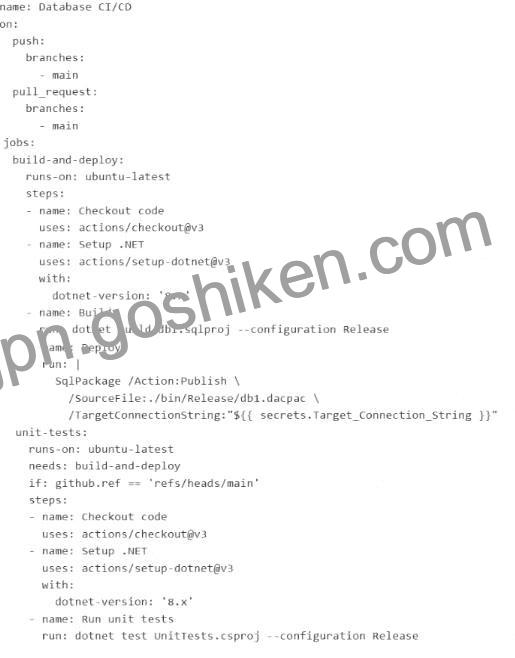
For each of the following statements, select Yes if the statement is true. Otherwise, select No. NOTE: Each correct selection is worth one point.


59、You have an Azure SQL database That contains a table named dbo.Products, dbo.Products contains three columns named Embedding Category, and Price. The Embedding column is defined as VECTOR(1536).
You use Ai_GENERME_EMBEDOINGS and VECTOR_SEARCH to support semantic search and apply additional filters on two columns named Category and Price.
You plan to change the embedding model from text-embedding-ada-002 to text-embedding-3-smalL Existing rows already contain embeddings in the Embedding column.
You need to implement the model change. Applications must be able to use VECTOR_SEARCH without runtime errors.
What should you do first?


60、Drag and Drop Question
You have an Azure SQL database that supports an OLTP application.
You need to write Transact-SQL code that returns blocking chain details. The output must return only sessions that are blocked or are blocking other sessions.
How should you complete the code? To answer, drag the appropriate values to the correct targets. Each value may be used once, more than once, or not at all. You may need to drag the split bar between panes or scroll to view content.
NOTE: Each correct selection is worth one point.

61、Case Study 1 – Contoso
Existing Environment
Azure Environment
Contoso has an Azure subscription in North Europe that contains the corporate infrastructure.
The current infrastructure contains a Microsoft SQL Server 2017 database. The database contains the following tables.

The FeedbackJsoncolumn has a full-text index and stores JSON documents in the following format.

The support staff at Contoso never has the UNMASKpermission.
Problem Statements
Contoso is deploying a new Azure SQL database that will become the authoritative data store for the following:
* AI workloads
* Vector search
* Modernized API access
* Retrieval Augmented Generation (RAG) pipelines
Sometimes the ingestion pipeline fails due to malformed JSON and duplicate payloads.
The engineers at Contoso report that the following dashboard query runs slowly.

You review the execution plan and discover that the plan shows a clustered index scan.
VehicleIncidentReportsoften contains details about the weather, traffic conditions, and location. Analysts report that it is difficult to find similar incidents based on these details.
Requirements
Planned Changes
Contoso wants to modernize Fleet Intelligence Platform to support AI-powered semantic search over incident reports.
Security Requirements
Contoso identifies the following security requirements:
* Restrict the support staff from viewing Personally Identifiable Information (PII) data, which is full email addresses and phone numbers.
* Enforce row-level filtering so that analysts see only incidents for the fleets to which they are assigned. The analysts can be assigned to multiple fleets.
Database Performance and Requirements
Contoso identifies the following telemetry requirements:
* Telemetry data must be stored in a partitioned table.
* Telemetry data must provide predictable performance for ingestion and retention operations.
* latitude, longitude, and accuracyJSON properties must be filtered by using an index seek.
Contoso identifies the following maintenance data requirements:
* Ensure that any changes to a row in the MaintenanceEventstable updates the corresponding value in the LastModifiedUtccolumn to the time of the change.
* Avoid recursive updates.
AI Search, Embeddings, and Vector Indexing
Contoso plans to implement semantic search over incident data to meet the following requirements:
* Embeddings must be stored in dedicated Azure SQL Database tables.
* Embeddings must be generated from rich natural language fields.
* Chunking must preserve semantic coherence.
* Hybrid search must combine the following:
– Vector similarity
– Keyword filtering or boosting
Development Requirements
The development team at Contoso will use Microsoft Visual Studio Code and GitHub Copilot and will retrieve live metadata from the databases.
Contoso identifies the following requirements for querying data in the FeedbackJsoncolumn of the CustomerFeedbacktable:
* Extract the customer feedback text from the JSON document.
* Filter rows where the JSON text contains a keyword.
* Calculate a fuzzy similarity score between the feedback text and a known issue description.
* Order the results by similarity score, with the highest score first.
You need to recommend a solution that will resolve the ingestion pipeline failure issues.
Which two actions should you recommend? Each correct answer presents part of the solution.
NOTE: Each correct selection is worth one point.


62、Hotspot Question
You have a SQL database in Microsoft Fabric that contains the following functions:
– A multi-statement table-valued function (TVF) named
Sales.mstvf_OrderStatus() that returns order status information
– A scalar user-defined function (UDF) named dbo.ufn_GetTaxMultiplier
(@TaxAmt money, @StateCode char(2)) that returns a numeric multiplier
used in tax calculations
Reporting queries frequently join Sales.mstvf_OrderStatus() to a table named Sales.SalesOrderHeader and return large result sets. A performance review shows that the queries produce inconsistent execution plans.
During a code review, a developer discovers that the following Transact-SQL statement produced an error.
EXEC @ret = ufn_GetTaxMultiplier @TaxAmt = 100.00, @StateCode = ‘WA’;
For each of the following statements, select Yes if the statement is true. Otherwise, select No.
NOTE: Each correct selection is worth one point.

63、Case Study 1 – Contoso
Existing Environment
Azure Environment
Contoso has an Azure subscription in North Europe that contains the corporate infrastructure.
The current infrastructure contains a Microsoft SQL Server 2017 database. The database contains the following tables.

The FeedbackJsoncolumn has a full-text index and stores JSON documents in the following format.

The support staff at Contoso never has the UNMASKpermission.
Problem Statements
Contoso is deploying a new Azure SQL database that will become the authoritative data store for the following:
* AI workloads
* Vector search
* Modernized API access
* Retrieval Augmented Generation (RAG) pipelines
Sometimes the ingestion pipeline fails due to malformed JSON and duplicate payloads.
The engineers at Contoso report that the following dashboard query runs slowly.

You review the execution plan and discover that the plan shows a clustered index scan.
VehicleIncidentReportsoften contains details about the weather, traffic conditions, and location. Analysts report that it is difficult to find similar incidents based on these details.
Requirements
Planned Changes
Contoso wants to modernize Fleet Intelligence Platform to support AI-powered semantic search over incident reports.
Security Requirements
Contoso identifies the following security requirements:
* Restrict the support staff from viewing Personally Identifiable Information (PII) data, which is full email addresses and phone numbers.
* Enforce row-level filtering so that analysts see only incidents for the fleets to which they are assigned. The analysts can be assigned to multiple fleets.
Database Performance and Requirements
Contoso identifies the following telemetry requirements:
* Telemetry data must be stored in a partitioned table.
* Telemetry data must provide predictable performance for ingestion and retention operations.
* latitude, longitude, and accuracyJSON properties must be filtered by using an index seek.
Contoso identifies the following maintenance data requirements:
* Ensure that any changes to a row in the MaintenanceEventstable updates the corresponding value in the LastModifiedUtccolumn to the time of the change.
* Avoid recursive updates.
AI Search, Embeddings, and Vector Indexing
Contoso plans to implement semantic search over incident data to meet the following requirements:
* Embeddings must be stored in dedicated Azure SQL Database tables.
* Embeddings must be generated from rich natural language fields.
* Chunking must preserve semantic coherence.
* Hybrid search must combine the following:
– Vector similarity
– Keyword filtering or boosting
Development Requirements
The development team at Contoso will use Microsoft Visual Studio Code and GitHub Copilot and will retrieve live metadata from the databases.
Contoso identifies the following requirements for querying data in the FeedbackJsoncolumn of the CustomerFeedbacktable:
* Extract the customer feedback text from the JSON document.
* Filter rows where the JSON text contains a keyword.
* Calculate a fuzzy similarity score between the feedback text and a known issue description.
* Order the results by similarity score, with the highest score first.
You need to recommend a solution to resolve the slow dashboard query issue. What should you recommend?


DP-800試験問題集でDP-800練習テスト問題:https://www.goshiken.com/Microsoft/DP-800-mondaishu.html

Related Links: myportal.utt.edu.tt myportal.utt.edu.tt myportal.utt.edu.tt myportal.utt.edu.tt myportal.utt.edu.tt myportal.utt.edu.tt