Rate this post

ISO-9001-Lead-Auditor無料認定試験材料はこちらの268問題

リアルISO-9001-Lead-Auditorは100%カバー率リアル試験問題を試そう!

質問19、 At the end of a second-party audit, the audit team enters the meeting room to hold the closing meeting; only two people are present and waiting for them: the Health and Safety supervisor and the administrative officer. Neither has participated in the audit. However, the team had previously agreed with the auditee Quality Manager on two nonconformities identified during the audit (NC1 and NC2).
They said:
Health and Safety supervisor: “Good evening. We are sorry to inform you that the general manager was involved in a serious car accident, and the other two managers have had to leave urgently to attend to the emergency.” Administration officer: “Our quality manager, before leaving, left a written message about ‘NC2’. He declares that the correction and corrective action have been already implemented and has attached some documents to the message as evidence of these actions. Therefore, he expects that ‘NC2’ will not be included in the report.” Which one of the following would be your preferred answer to the Quallty Manager’s request?


質問20、 Whistlekleen is a national dry cleaning and laundry company with 50 shops. You are conducting a surveillance audit of the Head Office and are sampling customer complaints. You find that 80% of complaints originate from five shops in the same region. Most of these complaints relate to damage to customer laundry.
The Quality Manager tells you that these are the oldest shops in the company. The cleaning equipment needs replacing but the company cannot afford it at the moment. You learn that the shop managers were told to dismiss most of the claims on the basis of the poor quality of the laundered materials.
On raising the matter with senior management, you are told that there are plans to replace the equipment in these shops over the next five years.
When reviewing the customer complaint file, you find that the organisation is facing a legal dispute with a customer over damage to an expensive cashmere coat.
Select the best option for how this should be handled by the Quality Management System.


質問21、 You, as auditor, are in dialogue with the quality lead and managing director of a small business that supplies specialist laboratory equipment and furniture.
You: “I’d like to look at how you manage change in the organisation. What changes have you made as a business, say, over the last 12 months?” Auditee: “We have made some strategic changes, the main one being that we no longer manufacture our own products in house.” You: “That sounds like quite a significant change. What has been the impact of that?” Auditee: “We now mainly sell other manufacturers’ products, under their brand names, and have outsourced manufacture of our own brand products to one of our suppliers. Unfortunately, we had to make six members of our staff redundant. This represents about 20% of our workforce, so this has been quite a challenging time.” You: “I’m sure. What were the reasons for making the change?” Auditee: “Our manufacturing section was a small operation, and we struggled to cope with fluctuations in demand. During busy periods, we found it hard to meet lead times, and in quiet periods we had staff with little to do. This was having an impact on customer satisfaction and meant we had to charge premium prices that made our product uncompetitive.” You: “How did you go about the change?” In relation to the auditor’s question about how the change was managed, the auditee mentions the steps listed below. Match the ISO 9001 clauses to the steps.
To complete the table, click on the blank section you want to complete so it is highlighted in red and then click on the ISO 9001 clauses listed below. Alternatively, drag and drop each clause to show which step the requirement applies to.

質問22、 You are auditing a manufacturer of specialty tea products during a Stage 2 certification audit. In the quality laboratory, you interview one of three operatives conducting sensory testing of a batch from the production line.
Select three options of evidence which could demonstrate conformance with clause 9.1.1 of ISO 9001:
2015.


質問23、 Scenario 2:
Bell is a Canadian food manufacturing company that operates globally. Their main products include nuts, dried fruits, and confections. Bell has always prioritized product quality and has maintained a good reputation for many years. However, the company’s production error rate increased significantly, leading to more customer complaints.
To increase efficiency and customer satisfaction, Bell implemented a Quality Management System (QMS) based on ISO 9001. The top management established a QMS implementation team comprising five middle managers from various departments, including Leslie, the quality manager.
Leslie was responsible for assigning responsibilities and authorities for QMS-related roles. He also suggested including a top management representative in the QMS team, but top management declined due to other priorities.
The team defined the QMS scope as:
“The scope of the QMS includes all activities related to food processing.” Leslie established a quality policy and presented it to the team for review before top management approval
. Top management also proposed a new strategy for handling customer complaints, requiring biweekly customer surveys to monitor customer perceptions.
Which statement related to the last paragraph of scenario 2 is correct?


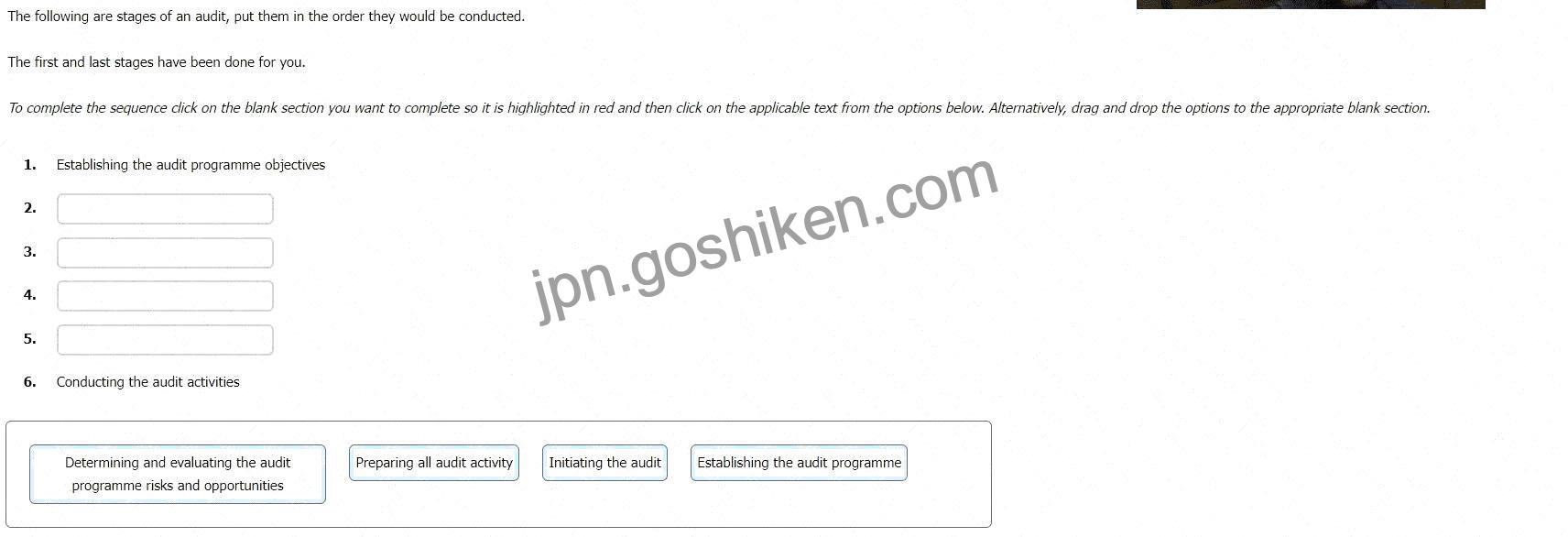
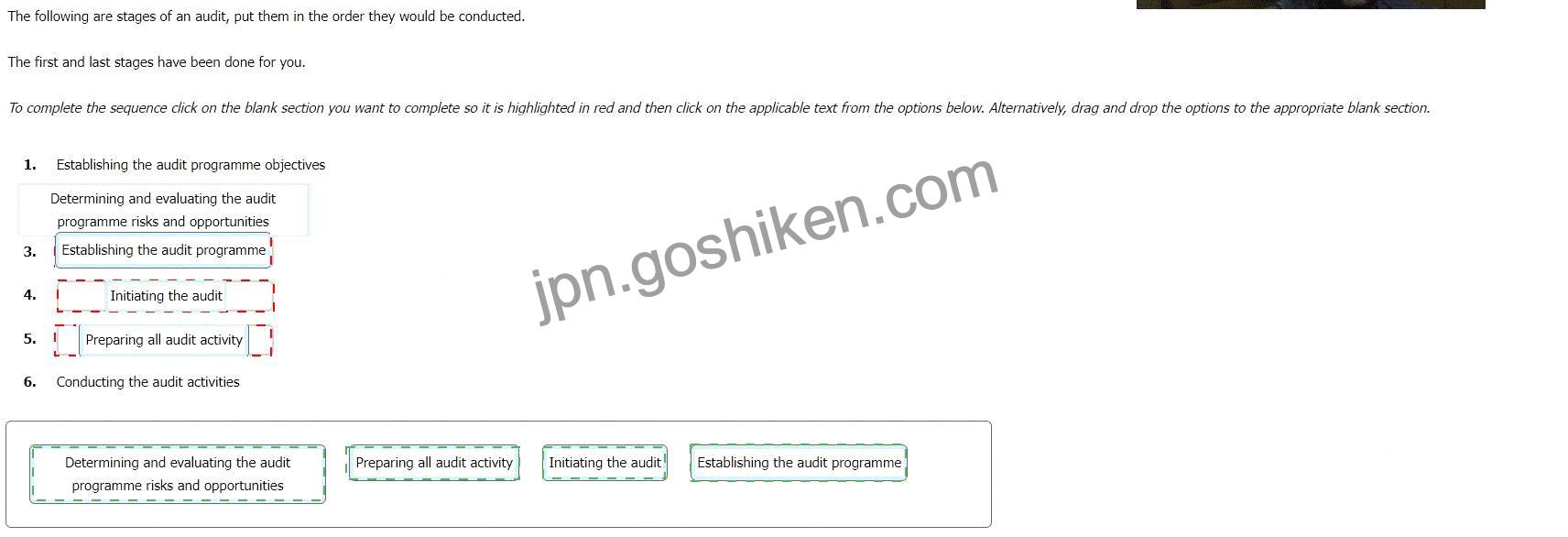
質問24、 The following are stages of an audit, put them in the order they would be conducted.
質問25、 Scenario 6: Davis Clinic (DC) is an American medical center focused on integrated health care. Since its establishment DC was committed to providing qualitative services for its clients, which is the reason why the company decided to implement a quality management system (QMS) based on ISO 9001. After a year of having an active QMS in place, DC applied for a certification audit.
A team of five auditors, from a well-known certification body, was selected to conduct the audit. Eva was appointed as the audit team leader. After three days of auditing, the team gathered to review and examine their findings. They also discussed the audit findings with DC’s top management and then drafted the audit conclusions.
In the closing meeting, which was held between the audit team and the top management of DC. Eva presented two nonconformities that were detected during the audit. Eva stated that the company did not retain documented information regarding its outsourced services for an analysis laboratory and regarding the conducted management reviews. During the closing meeting, the audit team required from DCs top management to come up with corrective action plans within two weeks. Although the top management did not agree with the audit findings, the audit team insisted that the auditee must submit corrective actions within the given time frame in order for the audit activities to continue.
Once the action plans were evaluated, the audit team began preparing the audit report. Eva required from the team to provide accurate descriptions of the audit findings and the audit conclusions. The report was then distributed to all the interested parties involved in the audit, including the certification body Based on the report, the certification body together with Eva, as the audit team leader, made the certification decision.
Based on the scenario above, answer the following question:
Why is it important to discuss the audit findings with DC’s top management prior to the closing meeting and the submission of the final audit report?


質問26、 Scenario 5: Mechanical-Electro (ME) Audit Stages
Mechanical-Electro, better known as ME, is an American company that provides mechanical and electrical services in China. Their services range from air-conditioning systems, ventilation systems, plumbing, to installation of electrical equipment in automobile plants, electronic manufacturing facilities, and food processing plants.
Due to the fierce competition from local Chinese companies and failing to meet customer requirements, ME’s revenue dropped significantly. In addition, customers’ trust and confidence in the company decreased, and the reputation of the company was damaged.
In light of these developments, the top management of ME decided to implement a quality management system (QMS) based on ISO 9001. After having an effective QMS in place for over a year, they applied for a certification audit.
A team of four auditors was appointed for the audit, including Li Na as the audit team leader. Initially, the audit team conducted a general review of ME’s documents, including the quality policy, operational procedures, inventory lists, QMS scope, process documentation, training records, and previous audit reports.
Li Na stated that this would allow the team to maintain a systematic and structured approach to gathering documents for all audit stages. While reviewing the documented information, the team observed some minor issues but did not identify any major nonconformities. Therefore, Li Na claimed that it was not necessary to prepare a report or conduct a meeting with ME’s representatives at that stage of the audit. She stated that all areas of concern would be discussed in the next phase of the audit.
Following the on-site activities and the opening meeting with ME’s top management, the audit team structured an audit test plan to verify whether ME’s QMS conformed to Clause 8.2.1 (Customer Communication) of ISO 9001.
To do so, they gathered information through group interviews and sampling. Li Na conducted interviews with departmental managers in the first group and then with top management. In addition, she chose a sampling method that sufficiently represented customer complaints from both areas of ME’ s operations.
The team members were responsible for the sampling procedure. They selected a sample size of 4 out of
45 customer complaints received weekly for electrical services and 2 out of 10 complaints for mechanical services.
Afterward, the audit team evaluated the evidence against the audit criteria and generated the audit findings.
According to general principles of sampling procedure, did the audit team select a valid sample for electrical services?


質問27、 You, as auditor, are in dialogue with the quality lead and managing director of a small business that supplies specialist laboratory equipment and furniture.
You: “I’d like to look at how you manage change in the organisation. What changes have you made as a business, say, over the last 12 months?” Auditee: “We have made some strategic changes, the main one being that we no longer manufacture our own products in house.” You: “That sounds like quite a significant change. What has been the impact of that?” Auditee: “We now mainly sell other manufacturers’ products, under their brand names, and have outsourced manufacture of our own brand products to one of our suppliers. Unfortunately, we had to make six members of our staff redundant. This represents about 20% of our workforce, so this has been quite a challenging time.” You: “I’m sure. What were the reasons for making the change?” Auditee: “Our manufacturing section was a small operation, and we struggled to cope with fluctuations in demand. During busy periods, we found it hard to meet lead times, and in quiet periods we had staff with little to do. This was having an impact on customer satisfaction and meant we had to charge premium prices that made our product uncompetitive.” You: “How did you go about the change?” In relation to the auditor’s question about how the change was managed, the auditee mentions the steps listed below. Match the ISO 9001 clauses to the steps.
To complete the table, click on the blank section you want to complete so it is highlighted in red and then click on the ISO 9001 clauses listed below. Alternatively, drag and drop each clause to show which step the requirement applies to.

質問28、 What does the application of the process approach in a QMS enable?


質問29、 Which of the following is a responsibility of a guide in an audit?


質問30、 Which quality management principle does an organization fulfill when it assesses risks, consequences, and impacts before taking action?


質問31、 Scenario 7: POLKA is a car manufacturing company based in Stockholm, Sweden. The company has around
14,000 employees working in different sectors which help with the design, painting, assembling, and test drives of the final product. The company is widely known for its qualitative products and affordable prices. In order to retain their reputation, POLKA implemented a quality management system (QMS) based on ISO
9001.
Before applying for certification, the company decided to conduct an internal audit to check whether there are any nonconformities in their QMS and if the requirements of ISO 9001 are being fulfilled. The top management appointed Sean, the internal auditor, as the team leader of the internal audit team. Sean required from the top management to have unrestricted access to the employees and executives of POLKA and to the documented information. Furthermore, Sean required to establish a team with a large number of auditors, considering the size and the complexity of the organization. The top management of POLKA agreed with Sean’s requirements.
The top management, in cooperation with Sean, assigned 10 more employees to the audit team. Following that. Sean planned the audit activities and assigned the roles and responsibilities to each auditor. They began by interviewing employees of different manufacturing departments to check whether they are aware of the process of the QMS implementation. While conducting these activities, one of the auditors asked Sean for permission to audit the department in which he worked on a daily basis, as he was very familiar with the processes of the department.
Along the way, the teams findings showed that the staff were trained, documented information was updated, and the QMS fulfilled the requirements of ISO 9001. The internal audit took three weeks to complete, and on the last week the audit team held a final meeting The team shared their results and together drafted the audit report This report was submitted to the top management of the company. The report was maintained as documented information, and was available to the relevant interested parties.
Based on the scenario above, answer the following question:
Scenario 7 states that Sean planned audit activities on his own. Is this acceptable?


質問32、 ISO 9001 is based on quality management principles. Match each of the following quality management principles to the related activity.

質問33、 How much time is usually spent on the Stage 1 audit?


PECB ISO-9001-Lead-Auditor 認定試験の出題範囲:

トピック 出題範囲
トピック 1
  • ISO 9001 監査の終了: このトピックでは、QMS 監査の終了と監査フォローアップ活動の実施に焦点を当てています。
トピック 2
  • 品質管理システムの基本原則と概念: このドメインの主な目的は、ISO 9001 の原則と概念を説明および適用するスキルを評価することです。
トピック 3
  • ISO 9001 監査の準備: このトピックでは、品質管理システム監査の準備に関連するサブトピックについて説明します。
トピック 4
  • 品質管理システム (QMS) 要件: ISO 9001 に基づく品質管理システムのさまざまな要件を指摘し、説明する能力を評価します。
トピック 5
  • ISO 9001 監査プログラムの管理: このトピックでは、QMS 監査プログラムを確立および管理する能力を評価します。


ISO-9001-Lead-Auditor試験問題集簡単なまとめ:https://www.goshiken.com/PECB/ISO-9001-Lead-Auditor-mondaishu.html

Related Links: www.stes.tyc.edu.tw myportal.utt.edu.tt www.stes.tyc.edu.tw www.stes.tyc.edu.tw myportal.utt.edu.tt myportal.utt.edu.tt